
How to Reconstitute Peptides: Step-by-Step Mixing Guide
How to reconstitute peptides correctly: choosing your bacteriostatic water volume, working out dosage math, mixing without denaturing, and storing the reconstituted vial.
Published 2026-05-03Updated 2026-05-2812 min read
By Ben — Builder of DoneDose, software engineer and peptide user
Reconstituting a peptide is just adding sterile water to a freeze-dried (lyophilized) vial of powder so you can draw and inject it. The mechanics are easy. The math trips up almost everyone the first time. How to reconstitute peptides correctly comes down to four things: using the right water, choosing a sensible volume, mixing without destroying the peptide, and being able to convert milligrams to insulin-syringe units without guessing. This guide walks through all of it -- with worked examples for the most common vial sizes -- so you finish with a vial that's accurately dosed, properly stored, and ready to go.
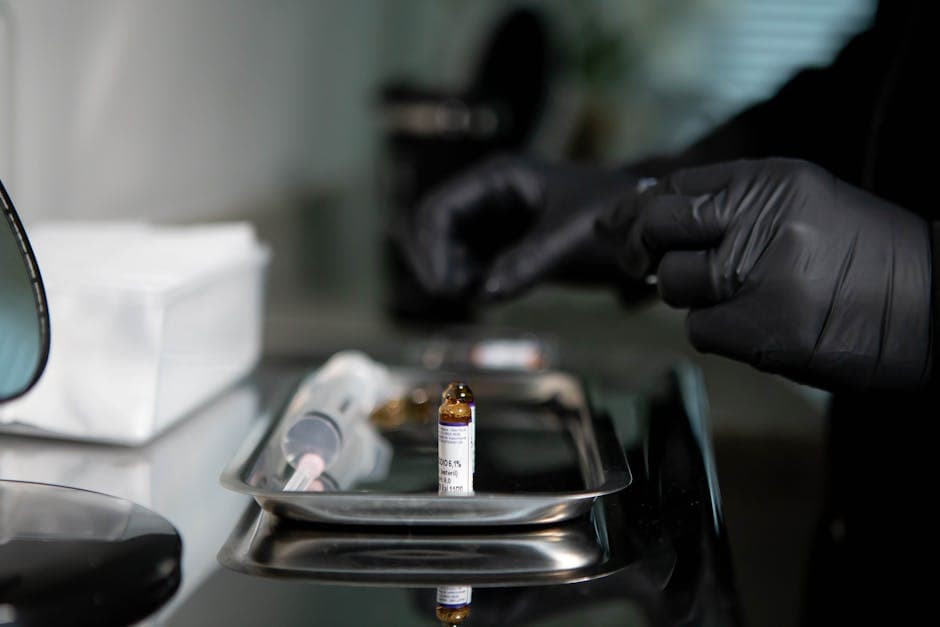
What You Need Before You Start
Reconstitution is a clean, simple procedure if you have everything ready. Improvising mid-mix usually ends with contaminated supplies or the wrong water volume.
| Item | Purpose | Notes |
|---|---|---|
| Lyophilized peptide vial | The freeze-dried powder | Should be a small puck or flake at the bottom of the vial |
| Bacteriostatic water | The sterile solvent | 0.9% benzyl alcohol preservative -- not sterile saline, not distilled water |
| Mixing syringe | Draws and adds the water | 3 mL syringe with a long draw needle, or an insulin syringe if reconstituting in 1 mL |
| Alcohol swabs | Sterilizes vial tops | Single-use, never reused |
| Insulin syringes | Draws and injects each dose | 1 mL / 100-unit syringes are the standard |
| Sharps container | Safe disposal | FDA-approved |
A note on water. Bacteriostatic water for injection (BAC water) contains 0.9% benzyl alcohol, which keeps bacteria from growing inside the vial after you puncture it. That's the whole reason you'd ever use it for a multi-dose vial. Sterile water for injection has no preservative -- it's fine for a single dose used immediately, but if you reconstitute a 30-day vial with plain sterile water, every time you puncture the stopper you risk introducing bacteria that have nothing stopping them.
You can also use 0.9% sodium chloride (saline) for injection in some cases, but saline doesn't have a preservative either, and certain peptides are less stable in saline. Default to bacteriostatic water unless your supplier explicitly recommends otherwise. Our bacteriostatic water guide covers the differences in more detail.
Step 1: Prep Your Workspace
Wash your hands. Lay everything out on a clean surface. Visually inspect the peptide vial:
- The freeze-dried puck should be a uniform color (usually white or off-white, sometimes very pale yellow)
- The vial should be intact and the rubber stopper undamaged
- The cap should be undisturbed -- if the metal seal is loose or broken, set it aside
Wipe the rubber tops of both the peptide vial and the bacteriostatic water vial with alcohol swabs. Let them air-dry for 10--15 seconds. Wet alcohol can run down the sides of the vial and contaminate things you're about to puncture.
Step 2: Choose Your Reconstitution Volume
This is the step that confuses people because there's no single right answer. The amount of water you add doesn't change the amount of peptide -- it only changes the concentration. More water means a larger injection volume per dose; less water means a smaller, more concentrated injection.
Here's the practical guide for the most common vial sizes:
| Vial Size | Common BAC Water Amount | Resulting Concentration | Why |
|---|---|---|---|
| 2 mg | 1 mL | 2 mg/mL = 2,000 mcg/mL | Small vials, low total volume needed |
| 5 mg | 2 mL | 2.5 mg/mL = 2,500 mcg/mL | Standard reconstitution for most 5 mg peptides |
| 5 mg | 1 mL | 5 mg/mL = 5,000 mcg/mL | More concentrated -- small injection volume |
| 10 mg | 2 mL | 5 mg/mL = 5,000 mcg/mL | Standard for 10 mg vials |
| 10 mg | 3 mL | 3.33 mg/mL = 3,333 mcg/mL | Lower concentration, more comfortable larger injections |
Two principles to choose by:
-
Pick a volume that gives you "round" insulin syringe units for your typical dose. If your dose is 250 mcg and you reconstitute 5 mg in 2 mL (2,500 mcg/mL), each unit on a 100-unit insulin syringe = 25 mcg, so 250 mcg = 10 units. That's a clean, easy draw. If you'd reconstituted 5 mg in 2.5 mL (2,000 mcg/mL), each unit = 20 mcg, so 250 mcg = 12.5 units -- workable but you're now eyeballing half a unit.
-
Pick a volume that comfortably fits the injection site. SubQ injections tolerate up to about 1 mL comfortably, but smaller is always better. If your dose ends up at 0.5 mL of solution, that's fine. If it ends up at 0.05 mL, also fine -- a tiny SubQ volume is painless.
The default starting point most people use: 2 mL of bacteriostatic water per 5 mg vial, 3 mL per 10 mg vial. Adjust from there.
Step 3: Add the Water
Now the actual mixing. The technique here is gentler than most beginners expect.
- Draw your chosen volume of bacteriostatic water into the mixing syringe. For a 2 mL reconstitution, a 3 mL syringe is appropriate.
- Insert the needle into the peptide vial at an angle, with the bevel pointing toward the wall of the vial.
- Push the water in slowly, letting it run down the side of the glass rather than spraying directly onto the peptide puck. This is the single most important physical-handling step. Direct, fast water pressure on a fragile peptide can shred it before it dissolves.
- Withdraw the needle once all the water is in.
- Set the vial down and let it sit for 30--60 seconds. Many peptides will dissolve passively without any agitation.
- If needed, gently swirl the vial by rolling it between your palms or making slow circles on the counter. Never shake. Shaking introduces air bubbles, generates foam, and can denature the peptide.
The peptide should fully dissolve into a clear, colorless (or very faintly colored) liquid. Cloudy, particulate, or persistently lumpy solutions indicate a damaged peptide or contamination -- don't inject those.
Why not shake? Peptides are sequences of amino acids held together in three-dimensional shapes that depend on weak chemical bonds. Vigorous shaking applies mechanical force that can disrupt those bonds and unfold the peptide -- denaturing it the same way overheating an egg destroys the protein structure. A denatured peptide doesn't work the same way (or at all) as the intact molecule. Slow swirling is plenty.
Step 4: Do the Math (or Use a Calculator)
This is where most people freeze. The math is genuinely simple once you've done it twice, but the mental gymnastics around mixing milligrams, micrograms, milliliters, and "units" trips up nearly everyone.
The fundamental equation:
Concentration (mcg per insulin unit) = Total mcg in vial ÷ Total units of water added
An insulin syringe holds 100 units in 1 mL, so 1 mL of bacteriostatic water = 100 units, 2 mL = 200 units, 3 mL = 300 units.
Worked example 1: 5 mg vial, 2 mL water, 250 mcg dose
- 5 mg = 5,000 mcg
- 2 mL = 200 units
- 5,000 mcg ÷ 200 units = 25 mcg per unit
- 250 mcg target dose ÷ 25 mcg per unit = 10 units per dose
Worked example 2: 10 mg vial, 3 mL water, 300 mcg dose
- 10 mg = 10,000 mcg
- 3 mL = 300 units
- 10,000 mcg ÷ 300 units = 33.3 mcg per unit
- 300 mcg target dose ÷ 33.3 mcg per unit = 9 units per dose
Worked example 3: 2 mg vial, 1 mL water, 100 mcg dose
- 2 mg = 2,000 mcg
- 1 mL = 100 units
- 2,000 mcg ÷ 100 units = 20 mcg per unit
- 100 mcg target dose ÷ 20 mcg per unit = 5 units per dose
If you'd rather not do this every time, our free peptide reconstitution calculator handles the conversion automatically -- enter the vial size, water volume, and target dose, and it tells you how many units to draw. Always verify the calculator's output by walking through the math once, especially with a new peptide. A small input typo can result in a 10x dosing error.
Step 5: Label the Vial
This is the step everyone skips and then regrets. Once you've reconstituted, label the vial with:
- The peptide name
- The reconstitution date
- The total amount and the water volume (e.g., "5 mg / 2 mL")
- The concentration in mcg/unit (e.g., "25 mcg/unit")
Masking tape and a Sharpie work fine. The reason this matters: if you have multiple peptides reconstituted at the same time -- or if you're rotating through a stack -- the vials look identical. A mislabeled or unlabeled vial is the most common reason people end up dosing wrong.
DoneDose can store reconstitution details alongside your injection log, so the dose-per-unit math is always available when you sit down to inject. More on that in our best peptide tracker app guide.
Step 6: Store It Right
Once reconstituted, peptides are no longer shelf-stable. They need to be refrigerated at 36--46°F (2--8°C). Most reconstituted peptides remain stable for 4--6 weeks under refrigeration; some less stable peptides degrade faster.
A few storage rules:
- Don't freeze. Freeze-thaw cycles destroy peptide structure. Keep the vial in the refrigerator, not the freezer.
- Keep the vial out of light. Most fridges are dark anyway, but if yours has interior lighting, put the vial in a small box.
- Don't store the vial in the door. Door temperatures fluctuate every time the fridge opens. The middle shelf is more stable.
- Inspect before each use. Cloudy, discolored, or precipitated solutions shouldn't be injected. When in doubt, discard.
Our peptide storage guide covers temperature ranges, light exposure, and shelf life by peptide type in more detail.
Common Mistakes That Ruin a Reconstitution
After watching a lot of people learn this skill, the same handful of mistakes show up over and over:
- Adding water too fast or directly onto the peptide puck. Slows dissolution and can damage the peptide. Run it down the side of the vial.
- Shaking the vial instead of swirling. Denatures the peptide and creates foam.
- Using sterile water instead of bacteriostatic water for a multi-dose vial. Bacteria will grow once the vial is punctured.
- Eyeballing the water volume. A 0.5 mL difference at the reconstitution step changes every subsequent dose. Use a calibrated syringe and read the meniscus.
- Forgetting to label. Future-you opening the fridge in three weeks will not remember which vial is which.
- Storing in the freezer. Freeze-thaw destroys most peptides. Refrigerate, never freeze.
- Not waiting long enough for full dissolution. Some peptides take 5--10 minutes. Patience > vigorous mixing.
- Drawing from a foamy vial. Foam is air. Drawing from foam means inconsistent dosing. Wait for foam to settle before drawing.
A Note on Sourcing and Legality
This guide is about the technique of reconstituting a peptide you already have. It's not about how to obtain peptides, which varies enormously by jurisdiction. Many peptides discussed in research literature -- BPC-157, TB-500, CJC-1295, ipamorelin, and others -- are not FDA-approved for human use and are sold legally only as research chemicals. The legality of buying, importing, possessing, and using them depends on where you live and how the substance is classified there.
If you're working with a clinic-prescribed peptide (semaglutide, tesamorelin, sermorelin, etc.) the supply chain is regulated and pharmaceutical-grade. If you're working with research peptides from a third-party supplier, you're trusting that supplier's testing, sterility, and labeling -- which is a real risk. Buy from reputable sources that publish certificates of analysis. Don't reconstitute or inject anything you can't verify.
Reconstitution is a routine procedure that becomes muscle memory after a couple of vials. The pieces that beginners stumble on -- which water, how much water, how to handle the powder, how to convert mg to units -- are all solvable with a calculator, a label, and a clean prep surface. Once that's locked in, the rest of the peptide protocol (storage, injection, rotation, tracking) is the same as any other injectable. DoneDose stores reconstitution math alongside your injection log so you don't have to redo it every time you sit down to dose.